
MOVE while we still can… Part 2
17 September 2026
What exactly is ALS?
In my earlier post, I mentioned ALS as a sobering reminder of how precious our ability to move really is.
So I thought I would explain it a little more simply.
What is ALS? What causes it? Can it be prevented or treated? And what about glutathione and nutritional support?
What is ALS?
ALS stands for Amyotrophic Lateral Sclerosis.
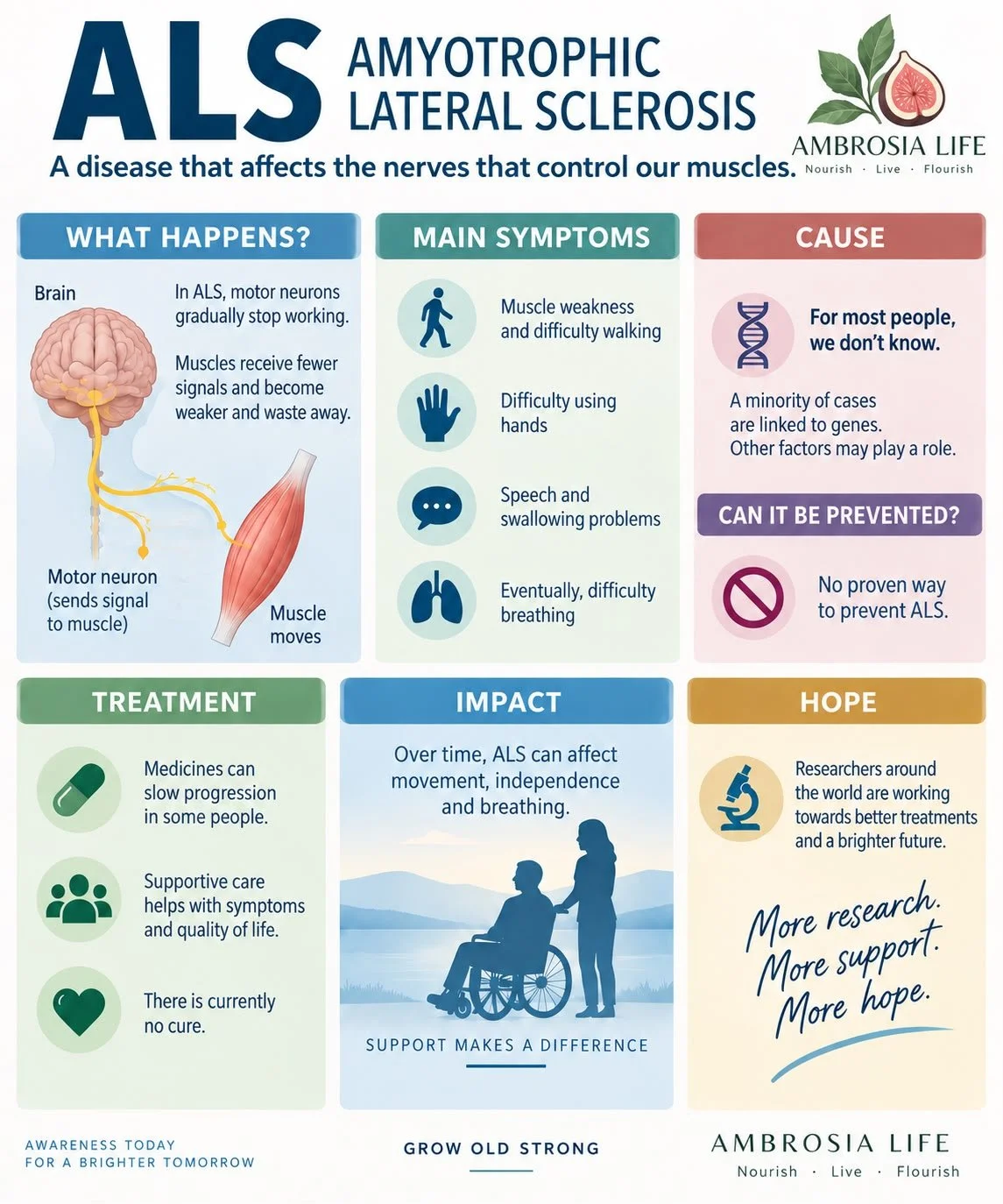
It is a progressive neurological disease affecting the motor neurons — the nerve cells that carry instructions from our brain and spinal cord to our muscles.
As these motor neurons deteriorate, the muscles receive fewer signals.
Over time, this can cause:
* Muscle weakness and wasting
* Cramps and stiffness
* Difficulty walking or using the hands
* Problems speaking and swallowing
* Eventually, difficulty breathing
This is why ALS can be such a devastating disease. The muscles themselves are not necessarily where the problem begins — the nerve cells controlling them are being progressively damaged.
What causes ALS?
For most people, we still don’t know exactly why ALS develops.
A minority of cases are strongly linked to inherited genetic changes, while most occur without a clear family history.
Researchers believe several biological processes may be involved, including:
Genetics • abnormal protein accumulation • mitochondrial dysfunction • oxidative stress • inflammation • glutamate excitotoxicity
Rather than one single cause, these processes may interact and gradually damage vulnerable motor neurons.
Can ALS be prevented?
At present, there is no proven way to prevent ALS.
A healthy diet, exercise, antioxidants and supplements have not been shown to prevent the disease.
That doesn’t mean looking after our muscles, metabolism and cellular health isn’t worthwhile.
It simply means we should distinguish between supporting good health and claiming that something can prevent ALS.
Can ALS be treated?
There is currently no cure, but there are treatments that can help.
Medicines such as riluzole and edaravone are used in ALS, and there are also targeted treatments for certain genetic forms of the disease.
Good ALS care is much broader than medication alone.
Nutrition, respiratory care, physiotherapy, swallowing and speech support, mobility assistance and maintaining body weight can all be extremely important in helping someone live as well as possible with the disease.
What about oxidative stress and GLUTATHIONE?
This is the area I find particularly interesting.
Our cells naturally produce reactive oxygen species (ROS) during normal metabolism.
Some are necessary for normal cellular signalling. But when their production exceeds our body’s ability to control them, we develop oxidative stress.
Oxidative stress and mitochondrial dysfunction are both important areas of research in ALS.
And one of our body’s most important natural antioxidant systems is:
GLUTATHIONE — GSH
Glutathione is made within our cells. It helps control oxidative stress and protect important cellular structures, including our mitochondria.
Interestingly, researchers have measured glutathione directly in the brains of people with ALS and found lower glutathione in the motor cortex compared with healthy individuals.
So why is it lower?
We don’t yet know.
One possibility is that lower glutathione leaves motor neurons with less antioxidant protection.
Another possibility is that ALS creates greater oxidative stress, causing cells to use up more glutathione as they try to defend themselves.
It could be a combination of both.
What we can say is that glutathione and oxidative stress are important areas of ALS research.
What we cannot yet say is that taking glutathione will prevent ALS or slow its progression.
That still needs proper clinical evidence.
So I see glutathione as support for our body’s natural cellular antioxidant system — not as a treatment for ALS.
What about the EB protocol?
This is where my interest in network antioxidants comes in.
Our antioxidant defence isn’t dependent on one antioxidant working alone. It is an interconnected cellular system.
🌿 VigourCells provides alpha-lipoic acid, CoQ10, vitamin C, vitamin E/tocotrienols and selenium, and helps boost the natural production of glutathione in our cells.
These nutrients have different roles in cellular antioxidant and mitochondrial systems. Selenium, for example, is required by glutathione-peroxidase enzymes, while alpha-lipoic acid is involved in cellular redox biology and may support glutathione-related processes.
🌿 Pine Bark provides antioxidant polyphenolic compounds.
🐟 Omega-3 EPA + DHA are important components of cell membranes and are involved in inflammatory signalling.
☀️ Vitamin D3 + K2 provides nutritional support for other areas of health, with vitamin D particularly important for normal muscle and bone function.
And what about liposomal glutathione? (EB’s latest product).
I see it as complementary rather than replacing the network:
Glutathione → provides glutathione
Network nutrients → support different parts of the wider cellular antioxidant and mitochondrial system and make glutathione.
This is why I prefer thinking about supporting the cellular network, rather than searching for one miracle antioxidant.
But importantly:
Neither glutathione nor the EB protocol is a proven treatment for ALS.
For someone living with ALS, neurological and multidisciplinary medical care must remain central.
Nutritional support can be considered alongside medical care, taking into account the individual’s nutritional needs, medications and medical condition.
What can the rest of us learn from ALS?
For me, studying ALS has reinforced something much bigger.
We cannot control or prevent every disease.
But we can appreciate and look after the body we have today.
Move while we can.
Maintain our muscles.
Eat well.
Sleep well.
Look after our metabolic health.
And supplement wisely.
Because sometimes we don’t realise what an extraordinary gift movement is until there is a possibility of losing it.
🌿 GROW OLD STRONG
Take care of tomorrow’s body today.
Eat well. Live well. Supplement wisely.