
Before Disease Rears Its Head — Protecting the Cellular Environment
Before Disease Rears Its Head — Protecting the Cellular Environment
(Macrophages from friend to foe in breast cancer cells?)
19/09/26
Today, I came across a fascinating new study that made me look at macrophages in a completely different way.
Macrophages are normally our friends. These immune cells patrol our tissues, clear microbes and damaged cells, coordinate inflammation and help with healing.
But a 2026 study by Hayward and colleagues, published in Cancer Cell, has uncovered another side to these important cells.
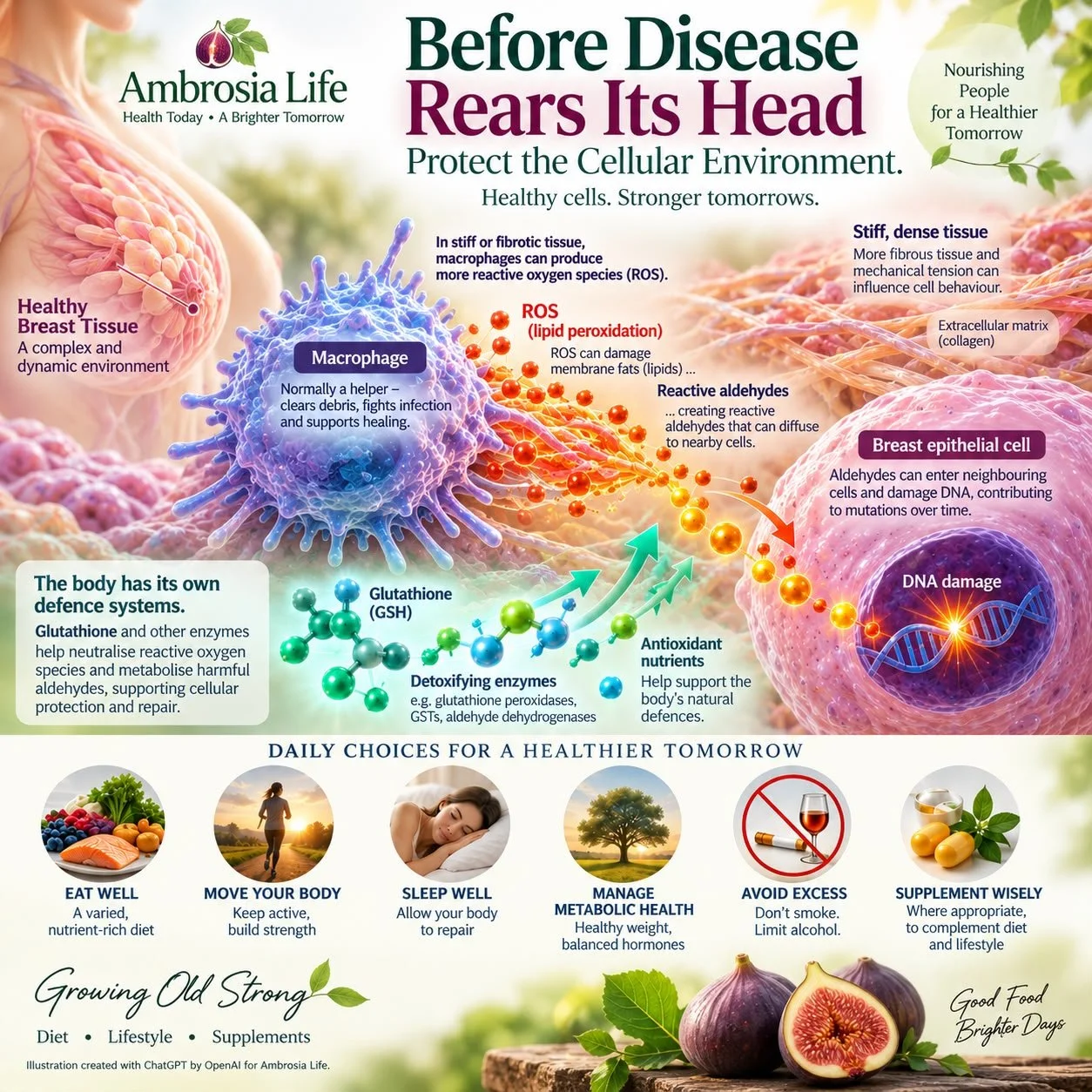
The researchers found that in stiff, fibrotic breast tissue, increased tissue tension can recruit macrophages and alter their behaviour. These macrophages generate reactive oxygen species (ROS), promoting lipid peroxidation — oxidative damage to fats within cell membranes.
This process produces reactive lipid-derived aldehydes that can diffuse into neighbouring breast epithelial cells and damage DNA. If such damage accumulates, it can contribute to mutations and potentially malignant progression.
The researchers also found increased lipid aldehydes and DNA damage in highly mammographically dense breast tissue, revealing an intriguing connection between tissue stiffness, inflammation, oxidative damage and the cellular environment in which cancer may develop.
Why this matters now
Breast cancer is being diagnosed in very large numbers worldwide.
Better screening and earlier detection explain part of this. Mammography now identifies cancers and very early lesions that might previously have remained undiscovered.
But screening does not appear to explain everything. Breast-cancer incidence has genuinely risen in some populations, probably for many reasons. Ageing, reproductive and hormonal factors, obesity and metabolic health, alcohol, physical inactivity and environmental and lifestyle influences may all play a part.
The lesson from the Hayward study isn’t that macrophages have suddenly become our enemy, or that oxidative stress alone causes breast cancer.
The more interesting message is that the environment surrounding our cells matters.
Ageing, inflammation, metabolic health, tissue changes and oxidative stress can interact over many years. This study gives us another glimpse of how that interaction may create conditions in which DNA damage can accumulate.
Our bodies are not defenceless
Fortunately, we have sophisticated systems for dealing with oxidative stress.
One of the most important is glutathione, a major intracellular antioxidant.
Glutathione works alongside enzymes such as glutathione peroxidases and glutathione-S-transferases to control oxidative damage and process some of the reactive products generated during lipid peroxidation. Aldehyde dehydrogenases and other enzymes also help metabolise potentially harmful aldehydes.
But oxidation itself is not the enemy.
Oxidation is part of life.
ROS have useful functions in immunity and normal cellular signalling. Problems arise when oxidative damage becomes excessive or persistent and overwhelms our ability to control it, repair the damage and clear harmful by-products.
This is why I have always been interested in supporting health before disease rears its ugly head.
Build resilience before you need it
No food or supplement can promise to prevent cancer.
But we can ask a much more useful question:
Are we giving our bodies the nutritional and lifestyle support they need to maintain their own defence and repair systems?
For me, good health begins with the fundamentals: eating a varied, nutrient-rich diet, keeping physically active, maintaining muscle, sleeping well, not smoking, limiting alcohol and paying attention to weight and metabolic health.
Supplements, when appropriate, should complement these foundations rather than replace them.
Where my EB protocol fits
This is why I developed and personally follow a simple core EB protocol built around VigourCells, Pine Bark and Omega + D3K2 (ODK).
VigourCells provides a network of antioxidant-related nutrients including vitamins C and E, alpha-lipoic acid, tocotrienols, CoQ10 and selenium.
I don’t think of these simply as individual antioxidants that “mop up free radicals.” What interests me much more is how nutrients can participate in and support the body’s own interconnected antioxidant systems.
Alpha-lipoic acid is a good example. Research has shown that ALA can support glutathione synthesis and increase cellular glutathione, in part by improving cysteine availability — an important building block required to make glutathione.
Selenium is also particularly relevant because it is required by glutathione peroxidase enzymes, which form part of the body’s defence against oxidative damage.
Vitamin E works within lipid environments as a chain-breaking antioxidant, helping interrupt lipid-peroxidation reactions, while vitamin C participates in the wider antioxidant network.
Pine Bark provides polyphenols that have been studied for their effects on oxidative stress and endogenous antioxidant pathways.
Omega-3 EPA and DHA become incorporated into cellular membranes and participate in normal membrane and inflammatory biology.
None of this means that the EB protocol has been shown to stop the mechanism discovered by Hayward and colleagues. It has not.
Nor am I suggesting that supplements prevent, treat or cure breast cancer.
My message is much simpler:
Look after the terrain in which your cells have to live
Our cells are exposed throughout life to metabolic stress, inflammation, ROS and environmental challenges. At the same time, our bodies possess remarkable antioxidant, detoxification and repair systems.
We may not be able to control every influence on our health. But we can take seriously the things that are within our control — how we eat, how much we move, how we sleep, our metabolic health and how wisely we use nutritional support.
Don’t wait for illness before becoming interested in cellular health.
Before disease rears its ugly head, take care of tomorrow’s body today.
That, to me, is what Growing Old Strong is really about.
Reference
Hayward, M.-K., Northey, J.J., Opazo-Mellado, V., et al. (2026). Tissue tension fosters macrophage-driven lipid peroxidation-induced DNA damage. Cancer Cell, 44. DOI: 10.1016/j.ccell.2026.03.022.