
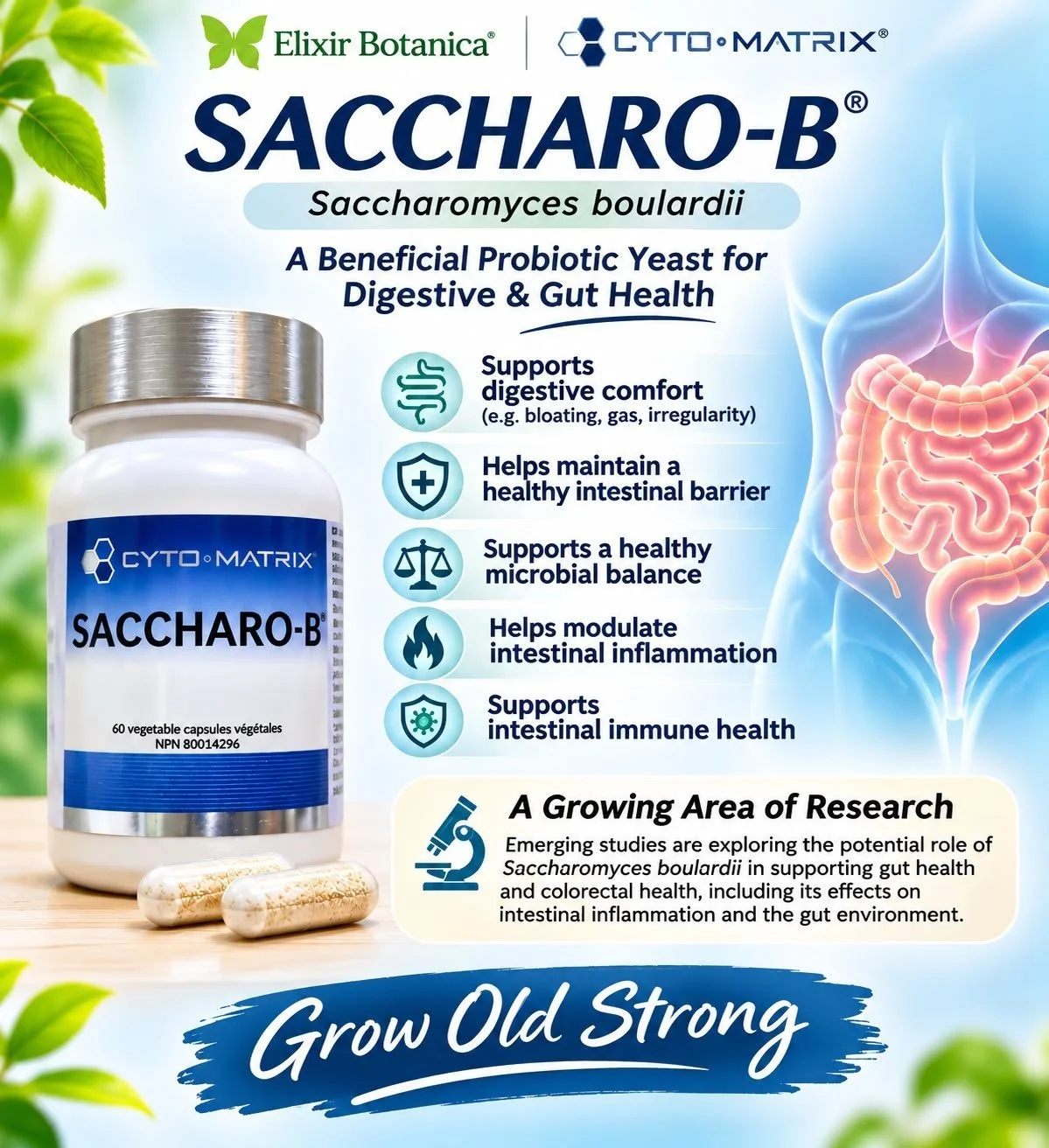
From digestive discomfort to emerging colorectal cancer research — why this remarkable probiotic yeast deserves our attention
By Rosemary Chng, MSc (NUS)
Elixir Botanica | Grow Old Strong
A Discovery That Began More Than a Decade Ago
Sometimes, a recommendation made many years ago can lead us on a fascinating journey of discovery.
Almost a decade ago, I was introduced to Saccharomyces boulardii, a beneficial probiotic yeast, through Dr Taylor Bean, an accomplished Canadian naturopathic doctor.
Dr Bean had previously practised in Singapore before returning to Canada, where she established TaylorMade Wellness in British Columbia.
I subsequently invited her back to Singapore to conduct wellness talks, sharing her knowledge of naturopathic and integrative medicine.
Dr Bean has a particular interest in digestive health, including small intestinal bacterial overgrowth (SIBO), irritable bowel syndrome (IBS) and other gastrointestinal conditions.
If I remember correctly, it was in connection with SIBO that she recommended Saccharomyces boulardii.
I was intrigued enough to introduce a product called Saccharo-B at Elixir Botanica.
Little did I realise that this humble probiotic yeast would become part of several meaningful personal experiences over the following decade.
My Mother-in-Law’s Experience: Still Going Strong at 90!
One of the first people I encouraged to try Saccharo-B was my mother-in-law.
For decades, she had struggled with chronic stomach discomfort, bloating and digestive problems.
When I discovered Saccharomyces boulardii, I thought it might be worth trying.
She found it helpful and continued taking it regularly.
Today, almost ten years later, she still takes Saccharo-B daily, together with VigourCells, our antioxidant supplement.
And she is now 90 years old!
She eats well, remains mentally alert, is mobile and continues to enjoy life.
It brings me tremendous joy to see her doing so well at this wonderful age.
Of course, I cannot attribute her longevity or overall wellbeing to these supplements alone. Healthy ageing involves many factors, including genetics, nutrition, lifestyle and medical care.
Nevertheless, I am grateful that Saccharo-B has remained part of her wellness routine during her older years.
Her experience also reminds me of something I strongly believe in:
Growing old should not simply mean living longer. It should mean living well, with mobility, independence and clarity of mind.
That is the heart of our Grow Old Strong philosophy.
Why I Continued Stocking Saccharo-B
Over the years, other clients also shared encouraging experiences with Saccharo-B.
Several had experienced painful, gassy and bloated stomachs, sometimes for prolonged periods.
They reported improvements in digestive comfort after taking the probiotic.
These personal accounts were encouraging, although they were not controlled clinical observations and could not establish that Saccharo-B was responsible for every improvement.
Nevertheless, they reinforced my interest in this unusual probiotic yeast.
For many years, I regarded Saccharo-B primarily as a supplement for digestive support.
Then something happened in 2024 that changed the way I looked at it.
2024: Paul’s Remarkable Journey With Stage 4 Colon Cancer
In late 2024, my dear friend, Paul, was diagnosed with Stage 4 colon cancer.
His prognosis was devastating. He was advised by his doctors to settle his affairs as soon as possible.
It was a deeply difficult time for him and his family.
During that period, I had a strong hunch about Saccharomyces boulardii, a probiotic yeast I had introduced at Elixir Botanica earlier.
I cannot fully explain why it came to mind, but I felt compelled to investigate the scientific literature.
My search led me to emerging research exploring the potential role of S. boulardii in colorectal cancer, including its experimental use in cancer treatment.
I was intrigued and encouraged by what I read.
Paul subsequently began taking Saccharo-B together with VigourCells, our antioxidant supplement, while continuing his prescribed cancer treatment.
More Than Two Years Later — Living Life to the Fullest!
Today, Paul continues to live with cancer and undergo chemotherapy. His cancer markers remain detectable, but according to the medical findings he has shared with me, there is currently no detectable cancer in his colon.
What encourages me even more is how he has continued living his life.
In 2025, he travelled to Uganda and Thailand for mission trips, continuing to serve others through his ministry.
More recently, he returned from a family holiday in Hokkaido, Japan.
Despite the challenges of living with cancer, he continues to travel, enjoy time with his family and pursue the ministry that means so much to him.
From being advised to settle his affairs to travelling, serving and enjoying life with his family — what an extraordinary journey!
I am deeply grateful for Paul’s progress and for his permission to share his story.
Of course, I cannot attribute his improvement to Saccharo-B or VigourCells. His chemotherapy and other medical treatments remain central to his cancer care, and we cannot determine whether the supplements contributed to his response, but we are hopeful they helped.
It was this experience that renewed my interest in the relationship between gut health, inflammation and colorectal cancer, and encouraged me to explore the emerging scientific research surrounding Saccharomyces boulardii.
What Exactly Is Saccharomyces boulardii?
Most probiotics contain beneficial bacteria, such as Lactobacillus and Bifidobacterium.
Saccharomyces boulardii is different.
It is a beneficial yeast rather than a bacterium.
Because of this, it is naturally resistant to antibacterial antibiotics, making it particularly interesting for supporting intestinal health during certain antibiotic treatments.
Unlike microorganisms that permanently colonise the gut, S. boulardii generally passes through the digestive tract and is cleared after supplementation stops.
During its passage, research suggests that it can interact with the intestinal environment in several ways.
It may help:
1. Maintain the intestinal barrier, which helps regulate what passes from the intestines into the bloodstream.
2. Interfere with certain harmful microorganisms, including some bacterial toxins and their effects on intestinal cells.
3. Modulate intestinal inflammation, through effects on immune and inflammatory signalling pathways.
4. Support intestinal immune responses, including mechanisms involved in defending the intestinal lining.
5. Help restore microbial balance following certain gastrointestinal disturbances.
Its role is not to eliminate every unwanted microorganism or sterilise the intestines.
Rather, it may help support the conditions needed for a healthier intestinal ecosystem.
What Does the Published Clinical Research Show?
1. Prevention of antibiotic-associated diarrhoea
One of the strongest areas of human clinical evidence concerns antibiotic-associated diarrhoea.
A systematic review and meta-analysis published in 2015 examined 21 randomised clinical trials involving 4,780 participants.
The researchers reported that S. boulardii supplementation reduced the risk of antibiotic-associated diarrhoea by approximately half.
This provides meaningful clinical evidence for its use in selected patients receiving antibiotics.
Reference: Szajewska H, Kołodziej M. (2015). Systematic review with meta-analysis: Saccharomyces boulardii in the prevention of antibiotic-associated diarrhoea. Alimentary Pharmacology & Therapeutics. PubMed.
2. Small intestinal bacterial overgrowth (SIBO)
This research is especially interesting because it connects with Dr Taylor Bean’s original recommendation.
SIBO can cause bloating, excessive gas, abdominal discomfort and altered bowel movements.
A randomised clinical study published in 2024 investigated S. boulardii CNCM I-745 in patients with liver cirrhosis and SIBO.
After three months of treatment, researchers reported that 80% of participants receiving the probiotic no longer had detectable SIBO, compared with 23.1% in the placebo group.
These findings were encouraging, although the study was relatively small and involved patients with a specific medical condition.
Further trials are needed before S. boulardii can be recommended as a routine standalone treatment for SIBO.
Reference: Efficacy and Safety of a Probiotic Containing Saccharomyces boulardii CNCM I-745 in the Treatment of Small Intestinal Bacterial Overgrowth in Decompensated Cirrhosis. (2024). Journal of Clinical Medicine, 13(3), 919. Full study.
3. The Emerging Research: Saccharomyces boulardii and Colorectal Cancer
This is the area that has renewed my personal interest.
Researchers increasingly recognise that the intestinal microbiome interacts with immune function, inflammatory signalling and the intestinal environment.
Certain microbial changes have been associated with colorectal cancer, although these relationships are complex and do not necessarily establish cause and effect.
Scientists are therefore investigating whether beneficial microorganisms could play a role in future preventive or therapeutic strategies.
2024: Engineered probiotic yeast as an experimental cancer therapy
A study published online in November 2024 in Cell Reports Medicine investigated a genetically engineered form of S. boulardii.
The researchers modified the yeast to deliver immune checkpoint-targeting proteins directly to intestinal tumours.
In a mouse model of colorectal cancer, the engineered yeast reduced intestinal tumour burden.
This was an interesting development because it demonstrated how probiotic yeast might be used as a vehicle for delivering experimental cancer treatments.
However, this was a preclinical study involving engineered yeast, not a human clinical trial involving ordinary probiotic supplements.
Reference: A yeast-based oral therapeutic delivers immune checkpoint inhibitors to reduce intestinal tumor burden. (2024). Cell Reports Medicine. PubMed.
2025: Ordinary Saccharomyces boulardii also shows interesting effects
A study published in Digestive Diseases and Sciences examined both engineered and unmodified S. boulardii in mice predisposed to inflammation-associated colorectal cancer.
The engineered yeast reduced the median number of tumours from 7.5 to 2 per mouse.
Importantly, researchers also observed reduced tumour numbers and intestinal inflammation in mice receiving ordinary, unmodified S. boulardii.
This was particularly interesting because it suggested that some effects might be associated with the yeast itself, rather than exclusively with genetic engineering.
However, the findings remain limited to an experimental animal model.
Reference: Culpepper T, et al. (2025). Engineered Probiotic Saccharomyces boulardii Reduces Colitis-Associated Colorectal Cancer Burden in Mice. Digestive Diseases and Sciences. PubMed.
2025: Another promising experimental direction
Researchers also investigated a genetically engineered S. boulardii strain capable of producing spermidine, a naturally occurring compound involved in cellular processes such as autophagy.
In mouse experiments, the engineered yeast improved measures of colitis and inflammation-associated colon cancer.
This adds to the growing scientific interest in developing microbiome-based approaches to gastrointestinal disease.
Reference: Mohaqiq M, et al. (2025). Engineered spermidine-secreting Saccharomyces boulardii ameliorates colitis and colon cancer in mice. Scientific Reports. PubMed.
2026: Reviewing its potential role in colorectal cancer
A review published in 2026 examined the possible role of S. boulardii in gastrointestinal disorders and colorectal cancer, particularly among higher-risk individuals.
The review discussed mechanisms involving intestinal inflammation, microbial balance and immune responses.
Although encouraging, the available evidence remains largely experimental.
Reference: Hameed AF, Noel KI, Akkila SS. (2026). The Role of Saccharomyces boulardii over Probiotics in Prevention and Treatment of Colorectal Cancer and Gastrointestinal Disorder in Potential High-Risk Individuals, Review of Current Evidence. Medical Journal of Bakirkoy. Read review.
What Can We Conclude From These Studies?
The published findings are interesting for several reasons.
They suggest that S. boulardii can influence aspects of intestinal inflammation, microbial interactions and immune signalling.
Some of these processes are relevant to colorectal cancer biology.
But we must distinguish between promising experimental research and proven clinical benefits.
At present, there is no convincing human clinical evidence that taking commercial Saccharomyces boulardii supplements prevents colorectal cancer, treats existing cancer or improves cancer survival.
The genetically engineered yeast used in some experiments is also very different from the Saccharo-B capsules available commercially.
The findings are therefore reasons for continued scientific investigation, rather than proof of cancer-prevention benefits.
Why I Have Decided to Take Saccharo-B Myself
After reflecting on Paul’s journey, my mother-in-law’s experience and the published research, I decided to revisit Saccharo-B for my own gut wellness.
I am currently taking one capsule daily and intend to continue for approximately two months. (The recommended dose is one twice daily).
My purpose is to support my intestinal health as part of my personal preventive wellness routine.
Colorectal cancer is a significant public health concern, and I believe we should pay greater attention to the health of our digestive system.
However, I recognise that there is no established clinical evidence that taking Saccharo-B for one or two months reduces colorectal cancer risk, but I feel there is no harm being proactive in supporting my gut health.
I see it as one possible component of a broader approach to gut wellness.
Equally important are eating a fibre-rich diet, staying physically active, maintaining a healthy weight, limiting alcohol, avoiding smoking and undergoing recommended colorectal cancer screening.
These are practical steps with established benefits for long-term health.
For those interested in probiotics, choosing an appropriate product and understanding its intended purpose are important.
Summary :
A Journey of Discovery and Gratitude
Looking back, I am grateful to Dr Taylor Bean for introducing me to Saccharomyces boulardii more than a decade ago.
What began as a recommendation for digestive health eventually became part of my mother-in-law’s daily wellness routine.
Over the years, I continued to hear encouraging feedback from clients who experienced digestive discomfort.
Then, in 2024, Paul’s cancer journey prompted me to investigate an entirely different area of research.
Today, I am fascinated by what scientists are discovering about the relationship between the gut microbiome, inflammation and colorectal health.
There is still much to learn.
But this experience has reminded me that preventive wellness begins with curiosity, awareness and the willingness to care for our bodies before problems arise.
A healthy gut deserves our attention at every age.
And as I often say:
Eat well. Live well. Supplement wisely.
Grow Old Strong.
Rosemary Chng, MSc (NUS)
Elixir Botanica
⸻
Important Safety Information
Saccharomyces boulardii is generally well tolerated by healthy adults, but it is not suitable for everyone.
People who are severely immunocompromised, critically ill or have central venous catheters should avoid live yeast probiotics unless specifically advised by their treating medical team. Rare cases of fungal bloodstream infection have been reported.
People with yeast allergies should avoid the product. Those taking antifungal medications should seek professional advice because the medications may reduce the probiotic’s activity.
Pregnant or breastfeeding women should seek professional guidance because safety evidence is limited.
People receiving chemotherapy or other cancer treatments should consult their oncology team before taking live yeast probiotics, particularly if their immune function is suppressed.
Persistent abdominal pain, unexplained weight loss, blood in the stool or significant changes in bowel habits require medical assessment.
Saccharo-B should not replace prescribed medical treatment or recommended colorectal cancer screening.
This article shares personal experiences and published research for educational purposes. The experiences described do not establish that either Saccharo-B or VigourCells treats or prevents cancer. Benefits observed in laboratory or animal experiments cannot be assumed to occur in humans.