
Creatine vs. VigourCells: Do You Still Need Creatine on the EB Protocol?
AI - generated image
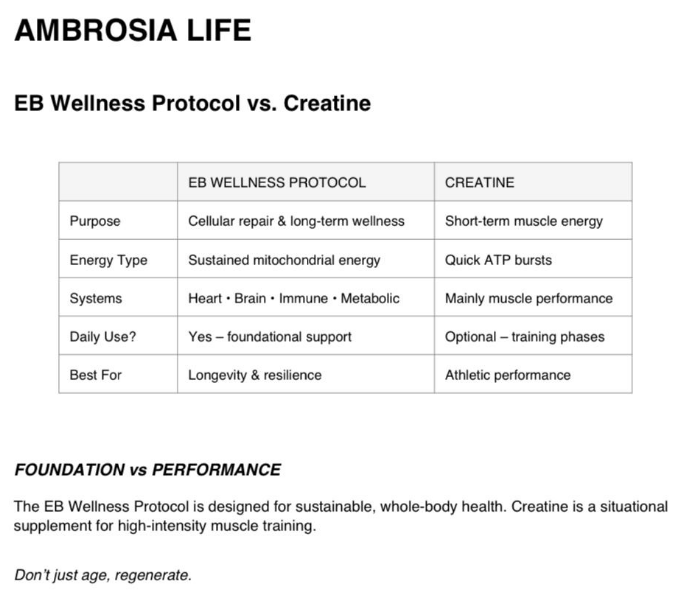
12/2/2026
Recently, there has been a lot of hype about creatine. It’s not a new thing and has been around especially in the body building and sports circle for ages. Only now, it’s starting to filter into mainstream markets.
Hence, many people ask about creatine — especially after hearing it helps with energy, muscles, and performance.
So a very common and sensible question is:
If I’m already on the EB Protocol and eat a balanced diet, do I still need creatine?
Let’s break this down simply.
⸻
🌿 What Creatine Does
Creatine is a natural compound found in our muscles and brain.
Its main role is very specific:
• It helps regenerate quick energy (ATP) during short bursts of activity
• Examples include:
• Heavy lifting
• Sprinting
• High-intensity workouts
Creatine is performance-focused, not a general wellness nutrient.
It is naturally found in:
• Meat
• Fish
• Eggs
Your body also produces some creatine on its own.
⸻
🌱 What VigourCells and the EB Protocol Do
The EB Protocol is designed very differently.
Instead of targeting short bursts of energy, it focuses on long-term cellular health and resilience.
The core EB Protocol supports:
• Cellular repair and regeneration
• Mitochondrial energy production
• Oxidative stress protection
• Brain, heart, immune, and metabolic health
At the heart of this protocol is VigourCells, a network antioxidant formula that helps the body:
• Produce energy more efficiently
• Protect cells from ongoing damage
• Support recovery and healthy ageing over time
This is foundational health support, not a temporary boost.
🥚 Is dietary creatine enough?
For most people — yes.
If you eat:
• Eggs
• Fish
• Poultry
• Meat
You already get sufficient creatine from food, and your body makes more as needed.
For everyday living, walking, light exercise, swimming, and normal strength maintenance, supplemental creatine is not necessary.
⸻
💬 So… do you need creatine if you’re on the EB Protocol?
For most people:
👉 No, you don’t.
If you are:
• Eating a balanced diet
• Taking the EB Protocol consistently
• Focused on long-term health, recovery, and vitality
Then your foundations are already well covered.
Creatine can be useful:
• During periods of intense strength training
• When pushing physical limits temporarily
But it is optional, not essential.
⸻
🌸 Key takeaway
• EB Protocol = daily foundation for health
• VigourCells = cellular engine
• Creatine = occasional add-on, only if needed
• Good diet + EB Protocol = sufficient for most people
If your goal is sustainable energy, healthy ageing, and cellular resilience, consistency with the EB Protocol matters far more than adding creatine.
Is this for everyone?
🌿 Is Creatine Safe?
For healthy individuals, creatine monohydrate at 3–5g per day has been extensively studied and is considered safe.
But “safe” does not mean “necessary for everyone.”
⸻
⚠️ Who Should Be Cautious or Avoid Creatine?
1️⃣ People with Kidney Disease or Reduced Kidney Function
Creatine increases blood creatinine levels (a breakdown marker).
In healthy people, this is harmless.
But in people with:
• Chronic kidney disease
• Reduced kidney filtration (low eGFR)
• Diabetic kidney damage
• History of kidney injury
Supplemental creatine may:
• Confuse kidney test interpretation
• Add unnecessary metabolic load
These individuals should avoid or only take under medical supervision.
⸻
2️⃣ People with Liver Disease
While creatine is not strongly hepatotoxic, those with:
• Elevated liver enzymes
• Active liver inflammation
• Fatty liver with abnormal labs
Should be cautious and not add unnecessary supplements without supervision.
⸻
3️⃣ People Prone to Dehydration
Creatine pulls water into muscle cells.
This can:
• Increase total body water
• Cause mild bloating
• Increase need for hydration
People who:
• Don’t drink enough water
• Live in hot climates
• Are elderly and drink little fluids
May experience:
• Muscle cramps
• Headaches
• Digestive discomfort
Hydration becomes important.
⸻
4️⃣ People With High Uric Acid / Gout
Creatine does not directly cause gout, but:
• High-protein + creatine + dehydration
may increase metabolic stress.
Those prone to gout should be cautious.
⸻
5️⃣ Teenagers Using It for Bodybuilding
This is common.
The issue is not toxicity — but:
• Often combined with stimulants
• Used excessively
• Taken without proper hydration
• Taken for appearance goals rather than health
It should not be casually used by adolescents without guidance.
⸻
🧠 Common Myths
❌ “Creatine damages kidneys in healthy people.”
→ No strong evidence supports this in healthy individuals.
❌ “Creatine is a steroid.”
→ Absolutely not. It is not hormonal.
❌ “Creatine causes muscle injury.”
→ Not supported when used properly.
⸻
🌱 So Is There Danger?
In healthy adults:
• Low risk
• Well studied
• Generally safe
But the real question is not just safety.
The question is:
Is it necessary?
For most people:
• Eating meat, fish, eggs
• Doing moderate exercise
• Focused on long-term health
Creatine is optional, not foundational.
⸻
📌 Who Truly Benefits Most?
Creatine is most helpful for:
• Competitive athletes
• High-intensity strength trainers
• Older adults with muscle loss (under supervision)
• Vegetarians/vegans (low dietary creatine intake)
⸻
🌿 In the Context of the EB Protocol
Your EB Protocol focuses on:
• Mitochondrial efficiency
• Antioxidant protection
• Circulation
• Inflammation control
• Long-term cellular repair
Creatine does not replace any of that.
It is a performance enhancer, not a regenerative foundation.
How is the supplement made? And do we have to be mindful of the source?
Very good question — this is where quality really matters.
Most people think creatine is “just creatine.”
But how it is made and where it is sourced absolutely makes a difference.
Let’s break this down clearly.
⸻
🧪 How Creatine Is Manufactured
Commercial creatine (usually creatine monohydrate) is not extracted from meat.
It is synthetically produced in factories.
The standard manufacturing process:
1. Sarcosine (derived from glycine)
2. Reacted with cyanamide
3. Under controlled heat and pressure
4. Crystallized into creatine monohydrate powder
When done properly, it produces:
• ~99.9% pure creatine monohydrate
• Stable white crystalline powder
But when manufacturing is poor, impurities can form.
⸻
⚠️ Possible Contaminants (if poorly made)
Low-quality creatine may contain:
• Creatinine (degraded form)
• Dicyandiamide (DCD)
• Heavy metals
• Industrial residual byproducts
These are usually present in very small amounts — but quality control matters.
This is why manufacturing standards and country of origin matter.
⸻
🌍 Does Source Matter?
Yes — especially in today’s supplement market.
Things to look for:
✔ GMP-certified facilities
(Good Manufacturing Practice)
✔ Third-party testing
Heavy metals, purity, contaminants
✔ Transparent origin
Some manufacturers are known for stricter quality control.
For example:
• German-manufactured creatine (e.g. Creapure®️) is often considered high purity.
• Some lower-cost bulk creatine from poorly regulated factories may not have the same oversight.
⸻
🧬 Forms of Creatine
You’ll see many marketing variations:
• Creatine monohydrate (most studied)
• Creatine HCL
• Buffered creatine
• Micronized creatine
Truthfully:
👉 Creatine monohydrate is the most researched and reliable form.
Most others are marketing variations.
⸻
🌿 Should You Be Mindful?
Yes — especially if:
• You already take multiple supplements
• You have kidney or liver concerns
• You value clean sourcing
• You live in hot climates where storage matters
• You are older and not using it for athletic performance
Since creatine is non-essential for most people, there is no reason to take a questionable product.
If someone chooses to take it:
• Choose reputable brands
• Avoid “mystery bulk” powders
• Avoid unnecessary loading phases
• Stay hydrated
⸻
🧠 In Our Context
You are already:
• Supporting mitochondrial efficiency (VigourCells)
• Supporting circulation and inflammation balance
• Eating adequate protein
Creatine becomes:
👉 Optional
👉 Situational
👉 Performance-focused
So yes — if taking it, be mindful of quality.
But for most people focused on long-term wellness, it is not a foundational necessity.
⸻
I have access to safe and effective creatine. Just let me know if you want some, as I don’t carry stock at the moment.