
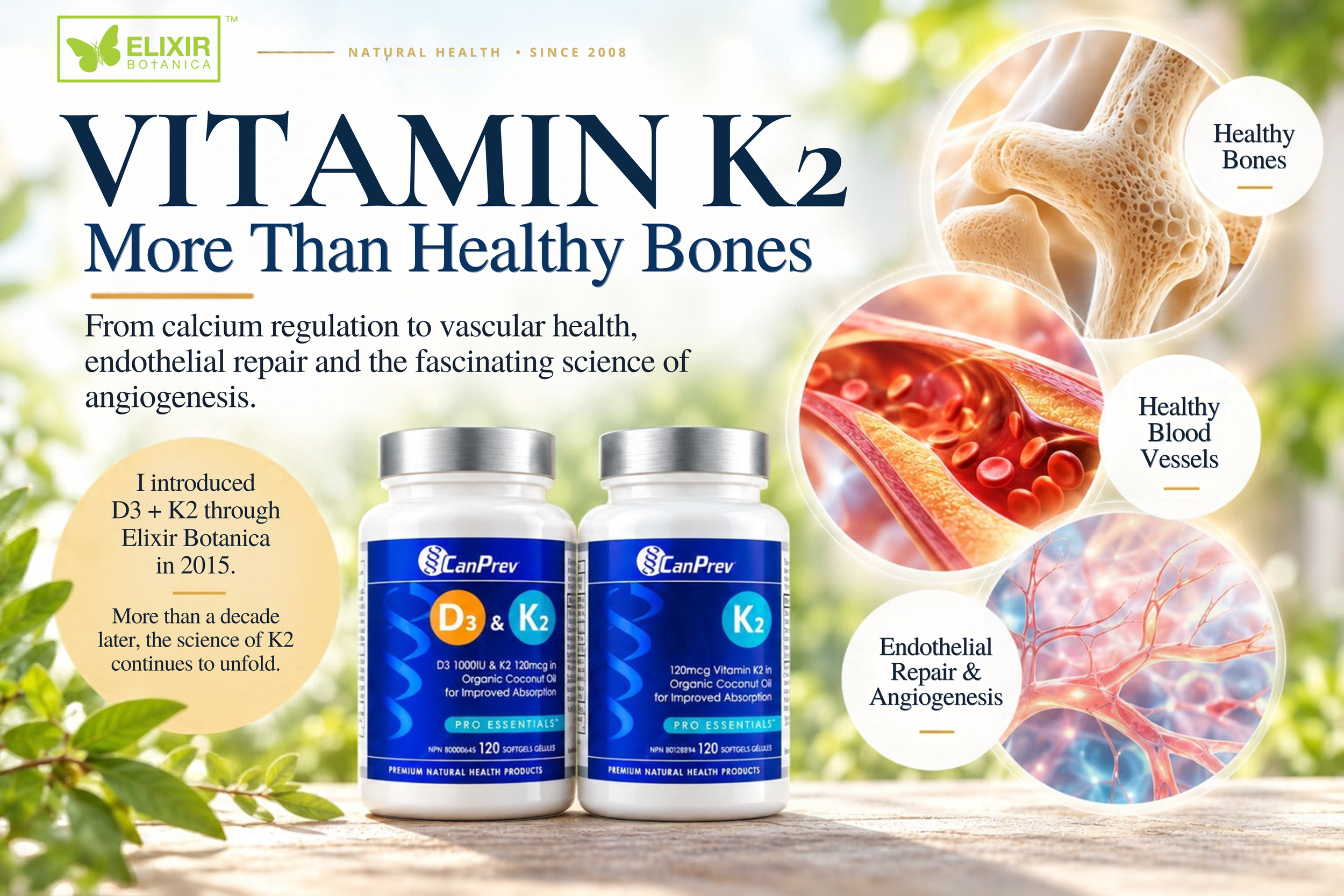
Vitamin K2 — More Than Healthy Bones
7/10/26
Vitamin K2 — More Than Healthy Bones
From calcium regulation to vascular health, endothelial repair and the fascinating science of angiogenesis
By Rosemary Chng, with research support from ChatGPT
More than a decade ago, in 2015, I introduced vitamin D3 together with vitamin K2 through Elixir Botanica to our customers in Singapore.
At the time, K2 was hardly the familiar supplement it is becoming today. I liked the combination because the science made sense to me: vitamin D3 supports calcium absorption and use, while vitamin K2 activates proteins involved in healthy bone mineralisation and calcium regulation.
So D3 + K2 became part of the nutritional support I recommended through Elixir Botanica—and something my family, my clients and I have continued to use over the years.
Today, we offer both D3 + K2 together and K2 on its own, giving those who already obtain sufficient vitamin D3 elsewhere the option of supplementing K2 separately.
What I find particularly gratifying is how the science has continued to evolve.
What we understood mainly in terms of calcium and healthy bones in 2015 has now expanded into fascinating research on vascular calcification, arterial health, endothelial protection and restoration, and even the regulation of angiogenesis.
So what exactly is vitamin K2, and why is this little-known vitamin becoming so interesting?
K2 occurs in certain animal and fermented foods. One of its richest dietary sources is the traditional Japanese fermented soybean food natto, which is particularly rich in MK-7.
MK-7 has attracted considerable research interest because it remains in circulation relatively long and has been widely studied as a supplemental form of K2.
K1 and K2 are not entirely separate vitamins. They share an important biochemical function:
Vitamin K helps activate vitamin-K-dependent proteins.
And that simple fact opens the door to a much bigger story.
Think of vitamin K as an activator
Our bodies produce several proteins that require vitamin K before they can function properly. Vitamin K enables a process called gamma-carboxylation. That sounds complicated, but for the layperson the important idea is simple:
Vitamin K helps switch certain important proteins into their functional form.
Different vitamin-K-dependent proteins perform very different jobs.
First, what is vitamin K?
For many years, most of us associated vitamin K with one thing: blood clotting.
That is certainly one of its essential functions. But vitamin K is actually a family of related nutrients, of which two forms are particularly important.
Vitamin K1
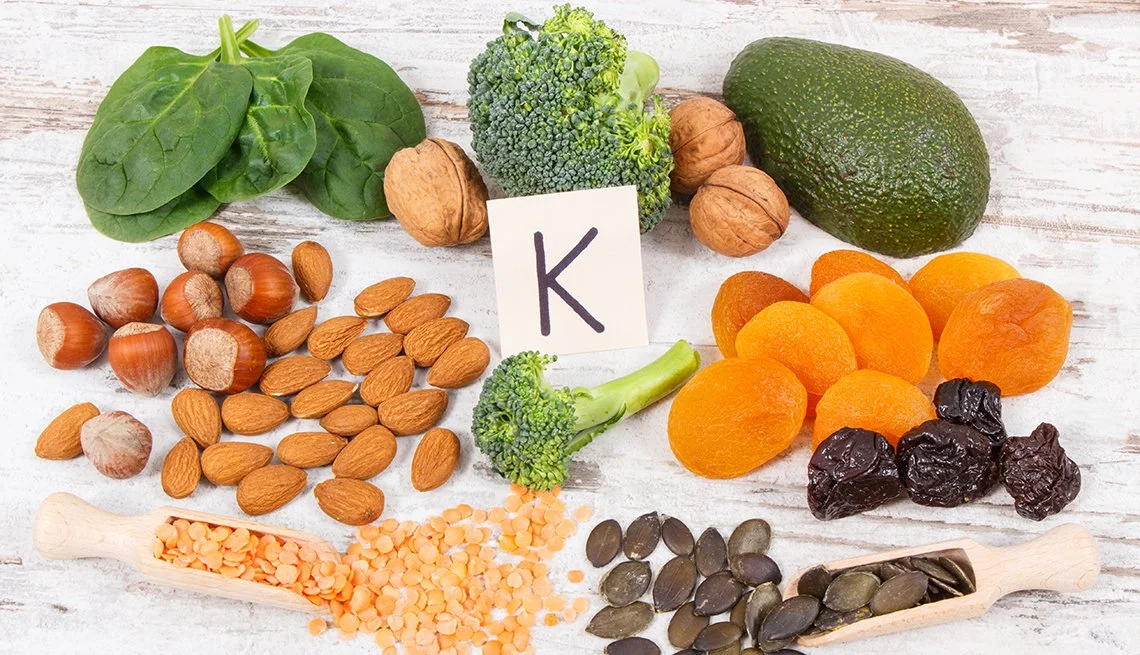
Vitamin K1, or phylloquinone, is found mainly in green leafy vegetables such as spinach, kale and broccoli.
It is particularly important for activating proteins involved in normal blood clotting.
Vitamin K2
Vitamin K2 refers to a family of compounds called menaquinones, including MK-4, MK-7, MK-8 and MK-9.
These are especially relevant to the K2 story:
Osteocalcin— involved in bone mineralisation.
Matrix Gla Protein (MGP) — involved in regulating inappropriate mineralisation in blood vessels.
Gas6 — involved in cell survi
This is why vitamin K2 has become so much more interesting than simply a “bone vitamin.”
K2 and healthy bones
Bone is living tissue. Throughout our lives, old bone is broken down and new bone is formed. One protein involved in this process is osteocalcin, produced by bone-forming cells called osteoblasts. Vitamin K helps activate osteocalcin so that it can bind to the mineral structure of bone. This is sometimes simplified into: “K2 sends calcium into the bones.”
This is a more accurate explanation:
K2 helps activate proteins involved in the body’s normal regulation and use of calcium, including osteocalcin in bone. This also explains why vitamin D3 and K2 make such a logical combination. Vitamin D helps the body absorb and use calcium.
Vitamin K activates proteins involved in how calcium is handled within tissues.They are different functions, but complementary ones. That was one of the reasons the D3 + K2 combination appealed to me back in 2015. But calcium doesn’t belong everywhere
Calcium is essential in our skeleton.
But mineralisation in the wrong place is another matter. Calcium can accumulate within arterial walls, particularly with ageing and cardiovascular disease. This brings us to another remarkable vitamin-K-dependent protein:
Matrix Gla Protein — MGP
MGP is produced in vascular tissues and is considered one of the body’s important natural inhibitors of inappropriate vascular mineralisation.
But MGP needs vitamin K-dependent activation to work properly.
So K2 isn’t physically picking calcium up from an artery and carrying it back into bone.
Rather:
K2 helps activate the body’s own proteins involved in regulating where mineralisation should—and should not—occur.
To me, this is a much more interesting way to understand K2. It participates in the body’s own calcium-regulating machinery.
What have human studies found?
This biological mechanism has led researchers to ask an obvious question: Could improving vitamin K status influence vascular health in people? Several human studies have begun to provide intriguing answers.
K2 and arterial stiffness
In a three-year double-blind randomised trial, 244 healthy postmenopausal women received either placebo or 180 micrograms of MK-7 daily. MK-7 substantially reduced circulating inactive MGP, demonstrating that the vitamin was having the expected biological effect.
Researchers also found improvements in some measures of arterial stiffness, particularly among women who had greater arterial stiffness at the beginning of the study. This was important because the research had moved beyond biochemical theory into measurable changes in human vascular function.
The 2026 coronary-calcium study
Then came another particularly interesting study. Published in JAMA Cardiology in 2026, the trial studied 180 adults with symptomatic coronary artery disease who already had measurable coronary artery calcium.
Participants received either placebo or:
360 micrograms of MK-7 daily for two years. Their coronary calcium was measured by CT scanning. Median coronary calcium scores progressed approximately as follows:
MK-7:
135 → 150 → 184
Placebo:
145 → 173 → 214
Calcium scores increased in both groups, so K2 did not make existing calcification disappear. But progression was significantly slower in the MK-7 group. That distinction matters. The study doesn’t tell us that K2 “cleans calcium out of arteries.”
Instead, it supports the much more biologically plausible idea that adequate vitamin K may help the body’s own mechanisms involved in regulating inappropriate vascular mineralisation. Whether slower calcium progression ultimately results in fewer heart attacks or strokes will require further clinical research. But it is an important development in the K2 story.
Then I discovered the endothelial story
This is perhaps the part of the newer research that I find most refreshing.
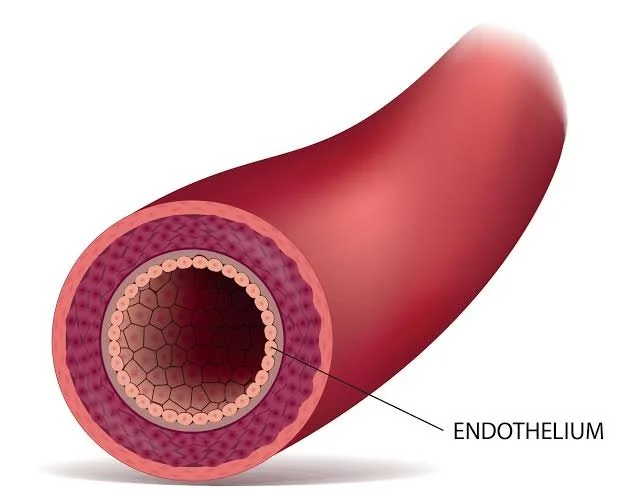
Every blood vessel in our body is lined by an extremely thin layer of cells called the endothelium. We could easily imagine it as simply the lining of a pipe. It is anything but.
The endothelium is a living, metabolically active system involved in:
blood-vessel relaxation, nitric oxide production, blood flow, inflammation, coagulation, vascular permeability and repair following injury.
Healthy endothelial function is fundamental to healthy blood vessels. And emerging research suggests that vitamin K biology may have a role here too. K2, nitric oxide and endothelial function
In a 2019 experimental study in mice prone to atherosclerosis, MK-7 improved nitric-oxide-dependent endothelial function and vasodilation. Nitric oxide is one of the important molecules produced by healthy endothelial cells. It helps blood vessels relax and supports normal vascular function.
This was an animal study, but it raised another interesting possibility: K2’s relationship with vascular health may extend beyond calcification.
Then came an even more intriguing discovery.
K2 and restoration of the endothelial lining
A 2026 study investigated the vitamin K recycling system inside endothelial cells.
Researchers found that MK-7 helped protect human coronary artery endothelial cells against lipid peroxidation and a particular type of oxidative cell death called ferroptosis. It also reduced inflammatory activation. But what caught my attention most was the animal experiment.
Following injury to the carotid artery, mice receiving an MK-7-enriched diet showed faster re-endothelialisation. That complicated word simply means: restoration of the protective endothelial lining after injury.
I find this fascinating.
For years, much of the K2 conversation revolved around calcium. Now scientists are exploring whether vitamin K biology may also contribute to the ability of vascular cells to protect and restore themselves following injury. This research is still emerging, but it opens another important chapter in our understanding of K2.
And then there is angiogenesis. This brings us to another fascinating aspect of blood-vessel biology: angiogenesis.
Angiogenesis is the formation of new blood vessels from existing vessels.
We need angiogenesis. When tissues heal or regenerate, new blood vessels may be needed to bring oxygen and nutrients into the area.
But the body doesn’t simply want as many new blood vessels as possible. It needs the right amount, in the right place, at the right time. This is why I prefer to think in terms of regulation and balance.
One of the body’s major signals for blood-vessel formation is:
VEGF — Vascular Endothelial Growth Factor
A simple way of thinking about VEGF is as one of the body’s:
“Grow blood vessels here” signals.
VEGF is important in normal healing and tissue repair. But the same biological mechanism can be exploited by disease.
Growing tumours, for example, require oxygen and nutrients. Cancer cells can produce VEGF and other signals that encourage blood vessels to grow towards the tumour and help establish its blood supply. So angiogenesis itself isn’t inherently good or bad. Healthy angiogenesis is regulated angiogenesis.
Where does K2 enter this picture?
Here we meet another vitamin-K-dependent protein:
Gas6 — Growth Arrest-Specific Protein 6
Gas6 interacts with a family of cell receptors known as TAM receptors and participates in processes involving: cell survival, inflammation, tissue repair, endothelial-cell behaviour and vascular signalling. Experimental research has shown that Gas6 can encourage endothelial cells to migrate, proliferate and form vessel-like structures—processes involved in angiogenesis. Because Gas6 is vitamin-K-dependent, it provides another intriguing connection between vitamin K and vascular biology. But the story becomes even more interesting when we look at abnormal angiogenesis.
What happens in cancer?
If K2 were simply a substance that increased angiogenesis everywhere, we might reasonably wonder whether it could encourage tumour blood-vessel growth. Experimental studies suggest the biology is far more sophisticated. In research involving prostate cancer cells, vitamin K2 was associated with reduced VEGF expression and reduced tumour-associated angiogenesis, alongside other effects on the cancer cells themselves. That does not make K2 a cancer treatment. But it illustrates an important point. K2 does not appear to fit neatly into a box labelled: “increases angiogenesis” or “decreases angiogenesis.”
Instead, vitamin-K-dependent biology appears to participate in a much larger network regulating vascular-cell behaviour. And that brings me to the concept I find most useful:
K2 and the regulation of healthy blood vessels
Our bodies don’t simply need more blood vessels or fewer blood vessels. We need healthy blood vessels that can:
function properly,
respond appropriately,
resist inappropriate mineralisation,
maintain a healthy endothelial lining,
repair damage,
regulate new vessel formation when necessary
K2 appears to intersect with several of these systems. Through osteocalcin, it participates in bone mineralisation.
Through MGP, it participates in regulation of vascular mineralisation. Through Gas6 and related signalling, vitamin K biology intersects with endothelial-cell survival and vascular signalling. Emerging research is also examining K2 in relation to oxidative protection, endothelial restoration and angiogenesis. That is a considerably broader picture than the one we had when we thought of K2 primarily in terms of healthy bones.
So what are the virtues of K2?
If I were explaining K2 simply today, I would describe it this way:
• K2 supports healthy bone mineralisation.
• K2 activates proteins involved in healthy calcium regulation.
• K2 activates MGP, one of the body’s natural inhibitors of inappropriate vascular mineralisation.
• Human studies suggest MK-7 may have beneficial effects on arterial stiffness and the progression of coronary calcification.
• Emerging research suggests vitamin K biology may also contribute to endothelial protection and restoration.
• Vitamin-K-dependent pathways participate in vascular signalling and the body’s regulation of angiogenesis.
Taken together, K2 increasingly looks like a nutrient involved not simply in bones, but in the maintenance and regulation of healthy vascular biology as we age.
K1 or K2 — do we need both?
I don’t see this as a competition between K1 and K2. Both belong to the vitamin K family. A healthy diet rich in leafy vegetables remains an excellent source of K1. K2 occurs in a smaller selection of foods, particularly fermented foods such as natto and certain animal-derived foods. For those who don’t regularly consume significant dietary sources of K2, supplementation provides another option.
That is why today, through Elixir Botanica, we offer both D3 + K2 and K2 individually.
For someone already obtaining sufficient vitamin D3 from another source, K2 alone provides the flexibility to supplement K2 without unnecessarily increasing their D3 intake.
Vitamin K’s role in activating vitamin-K-dependent proteins is established biology. Osteocalcin and MGP are well characterised, and we now have human randomised trials investigating MK-7 in arterial stiffness and coronary calcification. The newer research involving endothelial restoration, ferroptosis, Gas6 and angiogenesis remains largely experimental and needs further confirmation in humans.
So I would not describe K2 as a treatment for cardiovascular disease, stroke or cancer. And people taking warfarin or another vitamin-K-antagonist anticoagulant should discuss significant changes in vitamin K intake with the healthcare professional managing their medication. These boundaries don’t make the emerging research less interesting. They simply tell us where the science stands today.
Looking back after more than a decade
When I first introduced D3 + K2 through Elixir Botanica in 2015, my reasons were much simpler.
Vitamin D3 supported calcium absorption and bone health, while K2 complemented it through vitamin-K-dependent proteins involved in bone mineralisation and calcium regulation. That already made good biological sense to me.
So I am glad that my clients, my family and I have been taking D3 + K2 all these years. What I could not have known then was just how much more we would learn about K2.
Over the years, the conversation has expanded from bones and calcium to MGP and vascular calcification, then to arterial stiffness and coronary calcium, and now into fascinating new research on endothelial protection, vascular restoration and the regulation of angiogenesis.
For me, this is one of the joys of science. We don’t have to chase every new trend. We understand the biology as best we can, make thoughtful choices based on the evidence available—and continue learning as better research emerges.
Sometimes the science eventually takes us much further than where we started. And more than a decade after I first introduced D3 + K2, I am delighted to see that this small vitamin is turning out to have a much bigger story.
Selected References
1. NIH Office of Dietary Supplements. Vitamin K: Fact Sheet for Health Professionals.
2. Knapen MHJ, Braam LAJLM, Drummen NE, et al. Menaquinone-7 supplementation improves arterial stiffness in healthy postmenopausal women: a double-blind randomised clinical trial. Thrombosis and Haemostasis. 2015;113(5):1135–1144. doi:10.1160/TH14-08-0675.
3. Vossen LM, de Leeuw PW, Schurgers LJ, et al. Two Years of Menaquinone-7 Supplementation and Coronary Artery Calcification: A Randomized Clinical Trial. JAMA Cardiology. 2026;11(8):719–726. doi:10.1001/jamacardio.2026.1279.
4. Repges E, Aksoy A, Czogalla-Nitsche KJ, et al. VKORC1L1-mediated vitamin K recycling counters ferroptosis to promote endothelial repair. Scientific Reports. 2026;16:19171.
5. Kim YS, Jung SH, Jung DH, et al. Gas6 stimulates angiogenesis of human retinal endothelial cells and of zebrafish embryos via ERK1/2